
Return to Personality Theories Table of Contents
OTTO RANK
1884 - 1939
Biography
Instructor's addition: This biographical section was added by Rodger Rossman and was not part of Dr. C. George Boeree's original text.
Early Life and Possible Influences
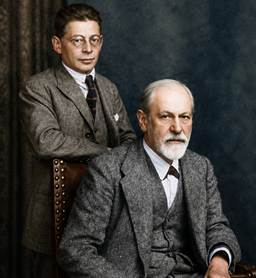
as Freud's favorite in 1922
Edited from an image on Wikimedia Commons
Otto Rank was born Otto Rosenfeld in Vienna on April 22, 1884. He grew up in a poor Jewish family and reportedly had a difficult relationship with his father, an artisan who struggled with alcoholism. Rank was much closer to his mother. Since the family could afford an advanced education for only one son, his older brother studied law while Rank attended trade school and became a locksmith.
Rank nevertheless educated himself through extensive reading in literature, philosophy, mythology, history, music, and science. As an adolescent, he rejected his father's surname and began calling himself Otto Rank. Biographers have described this change of name as an early act of self-creation. Around the age of twenty, Rank also experienced a period of severe depression followed by what he considered a spiritual rebirth.
We cannot know with certainty how directly these experiences produced Rank's theories. However, they resemble themes that would later become central to his work: separation from parents, resistance to authority, the development of an independent will, psychological rebirth, and the creative construction of one's own identity.
Freud became Rank's mentor and welcomed him into the center of the psychoanalytic movement. Rank became one of Freud's closest collaborators. In 1906, he became the paid secretary of the Wednesday Psychological Society, which in 1908 was renamed the Vienna Psychoanalytic Society. It was the first paid job in the history of the psychoanalytic movement. It allowed Rank to work closely as Freud's right-hand man for nearly two decades.
He also joined Freud's Secret Committee, directed the psychoanalytic publishing house, and edited its leading journals. In practical terms, he stood near the center of Freud's movement. Source: University of Pennsylvania Archives.
Then Rank published The Trauma of Birth in 1924. By arguing that separation at birth preceded the Oedipus complex as the foundation of anxiety, he challenged one of Freud's central ideas. In doing so, Rank asserted his own ideas against this powerful intellectual authority. The disagreement gradually ended a professional and personal relationship that had lasted about twenty years. He ultimately left Vienna, developed a more relational and present-focused form of therapy, and influenced later humanistic and existential therapists. Source: Freud Museum London.
His early separation from his father and his later separation from Freud parallel the process described in his theory. His life appears to illustrate one of his central beliefs: becoming an individual requires the courage to separate from the people and institutions that once provided protection and belonging.
Freud himself recognized this recurring pattern in his emotional life:
"An intimate friend and a hated enemy have always been indispensable requirements for my emotional life; I have always been able to create them anew..."
Rank's departure illustrates this pattern within Freud's professional relationships. Freud formed close relationships with talented collaborators, but he strongly defended what he considered the essential foundations of psychoanalysis. When associates such as Alfred Adler (9 years), Carl Jung (7 years), Karen Horney (28 years), and Otto Rank (20 years) developed ideas that challenged those foundations, an intimate friend could become a professional and personal enemy.
Otto Rank came to the United States and settled in New York in 1936. In 1939, he developed a kidney infection and suffered a severe allergic reaction to the drug used to treat it. The reaction ended his life. He was 55 years old.
Theory
A fascination with mythology, literature, art, and religion was hardly restricted to Carl Jung and Sigmund Freud. In fact, it comes up again and again among personality psychologists. It is especially prominent in Otto Rank.
The hero
One of his earliest works was The Myth of the Birth of the Hero, in which he examines such birth myths as those of the Babylonian kings Gilgamesh and Sargon, the Hindu hero Karna, the Persian King Cyrus, the Greek heroes Oedipus, Hercules, Paris, and Perseus, the Roman founders Romulus and Remus, the Celtic hero Tristan, the Germanic heroes Siegfried and Lohengrin, and even Moses, Buddha, and Jesus.
He finds the same pattern over and over again: There is a king and queen or god and goddess or other highly placed couple; something makes the hero's conception difficult or impossible; there is a dream or oracle prophesying his birth, often including a warning of danger to the father; the infant hero is usually left to die in a box, basket, or small boat, floating on the water; he is rescued and nurtured by either animals or people of very low birth; he grows up, discovers his true parents, takes revenge on his father, and finally receives the honors due him.
Rank finds the myths relatively simple to understand: As children, we worship our parents. But as we get older, they begin to get in our way, and we discover they were not all they seemed. The myth reflects a wish in all of us for a return to the comforting days when we thought our parents were perfect and gave us the attention we felt we deserved. The box or basket symbolizes the womb, and the waters symbolize our birth. The "people of low birth" symbolize our weak and unappreciative parents. The king and queen symbolize what they should be like. And the revenge is our anger at how they have mistreated us.
But notice that Rank doesn't bring sexuality into the picture, and doesn't refer to a collective unconscious. The myths are simply the expressions different cultures have given to common childhood experiences. His interpretation may not be perfect, but its humility is refreshing!
The artist
Rank also tackles the difficult issue of artistic creativity. On the one hand, Rank says, the artist has a particularly strong tendency towards glorification of his own will. Unlike the rest of us, he feels compelled to remake reality in his own image. And yet a true artist also needs immortality, which he can only achieve by identifying himself with the collective will of his culture and religion. Good art could be understood as a joining of the material and the spiritual, the specific and the universal, or the individual and humanity.
This joining doesn't come easily, though. It begins with the will, Rank's word for the ego, but an ego imbued with power. We are all born with a will to be ourselves, to be free of domination. In early childhood, we exercise our will in our efforts to do things independently of our parents. Later, we fight the domination of other authorities, including the inner authority of our sexual drives. How our struggle for independence goes determines the type of person we become. Rank describes three basic types:
The Types
First, there is the adapted type. These people learn to "will" what they have been forced to do. They obey authority, their society's moral code, and, as best as they can, their sexual impulses. This is a passive, duty-bound creature that Rank suggests is, in fact, the average person.
Second, there is the neurotic type. These people have a much stronger will than the average person, but it is totally engaged in the fight against external and internal domination. They even fight the expression of their own will, so there is no will left over to actually do anything with the freedom won. Instead, they worry and feel guilty about being so "willful." They are, however, at a higher level of moral development than the adapted type.
Third, there is the productive type, which Rank also refers to as the artist, the genius, the creative type, the self-conscious type, and, simply, the human being. Instead of fighting themselves, these people accept and affirm themselves and create an ideal, which functions as a positive focus for will. The artist creates himself or herself, and then goes on to create a new world as well.
Life and Death
Another interesting idea Rank introduced was the contest between life and death. He felt we have a "life instinct" that pushes us to become individuals, competent and independent, and a "death instinct" that pushes us to be part of a family, community, or humanity. We also feel a certain fear of these two. The "fear of life" is the fear of separation, loneliness, and alienation; the "fear of death" is the fear of getting lost in the whole, stagnating, being no one.
Our lives are filled with separations, beginning with birth. Rank's earliest work, in fact, concerned birth trauma, the idea that the anxiety experienced during birth was the model for all anxiety experienced afterwards. After birth, there's weaning and discipline and school and work and heartbreaks. But avoiding these separations is, literally, avoiding life and choosing death: never finding out what you can do, never leaving your family or small town, never leaving the womb!
So we must face our fears, recognizing that, to be fully developed, we must embrace both life and death, become individuals and nurture our relationships with others.
Conclusion
Otto Rank never founded a "school" of psychology like Freud and Jung did, but his influence can be found everywhere. He had a significant impact on Carl Rogers, a more subtle influence on Adler's later work and on the work of Fromm and Horney, as well as an influence on the existentialists, especially Rollo May. Other people have "reinvented" his ideas, and we can find bits and pieces of Otto Rank in competence motivation, reactance theory, and terror management theory.
Readings
If you would like to learn more about Otto Rank's theory, his most important works are Art and Artist, Truth and Reality, and Will Therapy.